
What is... Zero-Click Attribution?
Your complete guide to measuring marketing influence as attribution gets harder

Over 60% of searches now end without a click. B2B buyers ask ChatGPT “What’s the best ABM platform?”, read the AI’s answer, form opinions, and shortlist vendors without your analytics capturing a single trackable touchpoint. According to Bain research published March 2025, zero-click searches have become default behaviour, with click-through rates falling by 30% in B2B software categories. Meanwhile, 89% of B2B buyers use generative AI in at least one purchase stage, yet most marketing dashboards can’t prove ROI from this invisible influence. Your content might be winning market share whilst your GA4 dashboard shows flatlined organic traffic.
TL;DR
Traditional attribution models break when buyers consume your value proposition in AI summaries, featured snippets, and social feeds without clicking
Your brand could be shaping day-one shortlists whilst your analytics show declining engagement
Zero-click attribution can prove content marketing drives revenue even when website traffic is falling
Many searches end without clicks; traditional attribution misses this invisible influence driving B2B pipeline
There are four key measurement pillars: branded search lift, direct traffic spikes, self-reported attribution, and deal velocity compression
There can be an up to 90% measurement gap between attribution software credits and self-reported findings; social, podcasts, and communities get far less credit than they deserve
Primary tools needed: Google Analytics 4 (for baseline tracking), CRM with custom form fields (for self-reported data), manual AI query tracking (Share of Model)
Deals can close 15-30% faster when buyers discover you through AI, and 18-22% more people will search for your company name within 3-6 weeks of publishing a batch of content.

What is Zero-Click Attribution?
Definition: Zero-click attribution is a measurement framework that tracks marketing influence when users get answers directly from search results, AI summaries, or social platforms without clicking through to your website. It quantifies brand impact through correlation metrics like branded search lift, direct traffic spikes, self-reported attribution, and deal velocity improvements rather than traditional click-through rates.
Unlike legacy click-based measurement, zero-click attribution uses correlation analysis between content publication, AI citations, and downstream business signals. If you publish authoritative content and subsequently see lifts in branded search volume or direct traffic, that delta represents invisible influence. The click died, but content influence is higher than ever.
What Zero-Click Attribution Is Not
Before diving deeper, let’s clarify what zero-click attribution doesn’t do. It’s not a replacement for traditional attribution. It complements it by filling blind spots. It doesn’t track individual user journeys via cookies or UTM parameters. And it’s not about abandoning website traffic as a metric; rather, it recognises that website visits are now for verification, not discovery. Users arrive already knowing what you do because AI explained it elsewhere.
How Does Zero-Click Attribution Work?
Zero-click attribution operates on four core measurement pillars that B2B marketers can implement without additional software:
1. Content-to-Direct Traffic Correlation
Establish a baseline for “Direct Traffic” and “Branded Search” over six months using Google Analytics 4. Launch a content cluster targeting specific buyer questions. Wait 2-4 weeks for AI absorption (the time it takes for ChatGPT, Claude, Perplexity to index and cite your content). Measure the lift in direct and branded traffic above baseline. That delta is your zero-click attribution.
Example: You publish 15 comparison guides on “X vs Y” topics. Three weeks later, branded search increases 18% whilst organic landing page traffic stays flat. Traditional attribution misses this entirely. Zero-click attribution correctly credits your content strategy.
2. Self-Reported Attribution
Add an open-text field to lead gen or demo forms asking “How did you hear about us?” Analyse responses for phrases like “ChatGPT recommended you,” “Saw you in an AI summary,” or “Perplexity search.” When prospects say “Google” but your analytics show no corresponding ad click or organic landing page visit, that’s a zero-click conversion as they read the AI Overview and converted without clicking your site.
3. Deal Velocity Compression
Compare time-to-close for leads originating from Direct/Brand sources versus Paid Ads. AI-educated buyers often arrive better informed because the AI synthesis stripped the fluff and delivered core value. Successful zero-click strategies correlate with 15-30% shorter sales cycles for organic leads.
Assess your closed-won deals by first-touch source in your CRM. Calculate average days from first touch to close. Direct/Brand sources should show faster velocity than cold outbound or paid channels if your zero-click strategy is working.
4. Share of Model (SoM)
This replaces traditional “Share of Voice.” Run your top 50 category keywords through ChatGPT, Claude, Perplexity, and Gemini monthly. Score results: Tier 1 (primary recommendation), Tier 2 (comparison list), Tier 3 (citations), Tier 4 (not mentioned). Track the percentage of queries where you rank Tier 1 or 2. As SoM rises, Direct Traffic should rise in tandem.
Example query: “What’s the best RevOps platform for mid-market B2B SaaS?” Check which vendors AI recommends. Repeat for 20-50 category queries. Build a monthly scorecard showing your Tier 1 and Tier 2 mentions as a percentage.
Traditional attribution is like tracking shoppers who enter your physical store. Zero-click attribution tracks people who see your billboard, remember your brand, then search for you specifically three days later. The billboard worked, but legacy metrics gave it zero credit.
Zero-Click Attribution vs Traditional Attribution
Here’s how the two approaches differ:
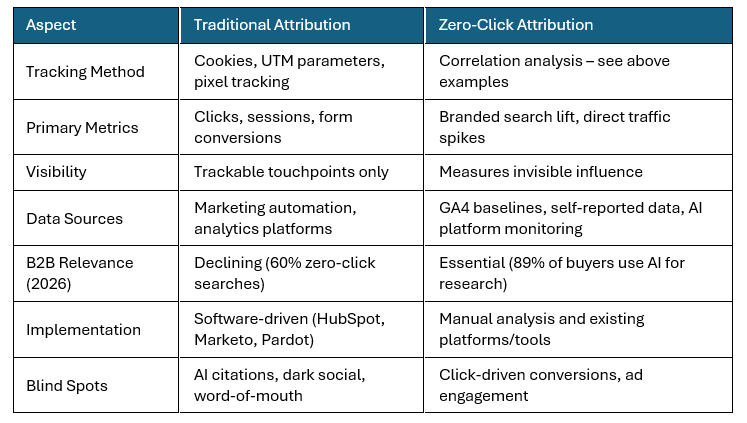
Table 1: Comparison of traditional and zero-click attribution approaches
Both approaches complement each other. Use traditional attribution for trackable touchpoints (e.g. ads, email marketing, gated content) whilst zero-click attribution measures invisible influence (e.g. AI citations, featured snippets, dark social shares). Together, they provide a fuller picture of content impact.
Why Zero-Click Attribution Matters for B2B Marketers
85% of B2B buyers purchase from their “day one” list, vendors they knew before actively searching. This creates a measurement issue: your content might be shaping those day-one lists whilst your analytics show declining engagement. Forrester reports 89% of B2B buyers use generative AI in at least one purchase stage, yet most marketing dashboards can’t prove ROI from AI visibility.
Zero-click attribution solves three critical problems:
1. Proves Content ROI in the AI Era
When traffic declines but pipeline stays strong, you can demonstrate correlation between content velocity and downstream revenue signals. Proving this can protect content budgets. CMOs could for example show: “After our Q4 content sprint, branded search increased 22% and direct traffic lifted 18%, whilst our sales cycle compressed by 12 days.”
2. Shifts Focus from Vanity Metrics to Influence Metrics
Rather than defending declining page views, you could report on branded search lift, share of AI citations, and sales cycle compression. RevOps and Finance teams care about pipeline velocity and customer acquisition cost payback, not impressions.
3. Reveals Dark Funnel Activity
32% of online sharing happens via “dark social” e.g. private Slack messages, WhatsApp groups, direct emails with no tracking parameters. When someone pastes a ChatGPT snippet mentioning your tool into Slack, attribution software sees “Direct” traffic with no context. Zero-click attribution can connect these dots through correlation and self-reported data.

Other Considerations
The Verification Shift: Website visits are now less about discovery; they’re now more for verification. Users arrive already knowing what you do because AI explained it. Bounce rates may rise (they got the answer elsewhere) whilst conversion rates on branded traffic are rising.
Culture Change Required: Sales and marketing must align on new metrics. When Sales closes a deal “from nowhere,” it’s often zero-click influence. RevOps teams need dashboards tracking correlation, not just clicks.
Proxy Metrics Become Primary: Impressions in featured snippets, brand mentions in AI Overviews, visibility in “People Also Ask,” and inclusion in voice assistant responses are now leading indicators of pipeline influence.
AI Citation = Modern PR: Being cited by ChatGPT, Claude, or Perplexity is the new analyst endorsement. Optimising for “citability” (clear answers, structured data, authoritative sources) is a content strategy.
The Answer-to-Brand Hop: Users ask AI a question → AI recommends your brand → user opens new tab and types your brand name directly. Old attribution calls this “Direct.” Zero-click attribution correctly credits your content.
Multi-Channel ABM Combats Zero-Click: Republishing content on third-party platforms, LinkedIn lead-gen forms, PR, and owned channels captures demand that may never generate website clicks. When buyers discover you via AI but download your syndicated report from partner sites instead of your website, you still capture their information, closing the attribution loop.*
How to Get Started
Implement these steps in sequence. Each step builds on the previous, creating a complete zero-click attribution system.
Step 1: Implement Self-Reported Attribution Fields
Add “How did you hear about us?” as a mandatory open-text field on all high-intent forms (e.g. demo requests, pricing inquiries, sales contact forms). Analyse responses monthly for mentions of AI tools, podcasts, communities, and “word of mouth.”
Step 2: Establish Traffic Baselines
Use Google Analytics 4 to find your average weekly Direct Traffic and Branded Search over the last six months. Then put the weekly numbers in a spreadsheet. Any week where those numbers are roughly 15–20% higher than your usual average should be treated as a special “event” worth digging into.
Step 3: Launch a Content Sprint
Target 10-15 buyer questions with clear, citation-ready answers. Structure each answer with: exact question as H2, concise definition (40-60 words), proof point with source and date, practical implication for the buyer’s role, and clear next step. Publish all content within 2-3 weeks. Wait three weeks for AI absorption.
Step 4: Measure Lift and Correlate
Compare Direct Traffic and Branded Search during weeks 4-8 post-publication against your baseline. Calculate percentage lift. If branded search increases 15%+ whilst organic landing page traffic stays flat, that branded search lift represents zero-click attribution. Document the correlation in a simple dashboard.
Step 5: Track Share of Model Monthly
Once you’ve chosen the 20 most important search phrases for your product or category, type each of those phrases into ChatGPT, Claude, and Perplexity and see what answers they give and whether your brand shows up in those answers. Do this monthly. Score where your brand appears. Calculate your percentage of Tier 1 and Tier 2 mentions. This becomes your AI visibility benchmark. Target 10-15% month-over-month improvement.
Step 6: Compare Deal Velocity by Source
Group your won deals based on how the customer first found you (came straight to your site or searched your brand name, clicked an ad, or landed on an SEO page). Then work out the average time it takes to close deals in each group. Studies suggest buyers who already know you from AI tools (the direct/brand group) should typically buy faster (some sources suggesting over 20% faster). If they don’t, investigate: are buyers arriving confused or well-informed?
FAQs
Q: How is zero-click attribution different from traditional attribution?
A: Traditional attribution tracks linear user paths via cookies and UTM parameters (search → click → read → convert). Zero-click attribution uses correlation analysis to measure influence when users consume content in AI summaries, featured snippets, or social feeds without clicking through to your site. Primary signals shift from click-through rate to branded search lift, direct traffic spikes, and self-reported attribution.
Q: Can zero-click attribution work alongside existing attribution models?
A: Yes. Zero-click attribution complements multi-touch attribution by filling blind spots. Use traditional attribution for trackable touchpoints (paid ads, email campaigns, gated content downloads) whilst zero-click attribution measures invisible influence (AI citations, featured snippets, dark social shares, word-of-mouth). Together, they provide complete visibility into content impact across the full buyer journey.
Q: What tools do I need to implement zero-click attribution?
A: Start with tools you already have: Google Analytics 4 (for branded search and direct traffic baselines), CRM with custom form fields (for self-reported attribution), and manual AI queries (for Share of Model tracking). Advanced teams add Semrush AI SEO Toolkit (tracks brand mentions across AI platforms), Google Search Console (impressions data including AI Overviews), and intent data platforms like 6sense or Demandbase (account-level engagement signals).
Q: How do I get executive buy-in when traffic is declining?
A: Reframe the narrative from “traffic is down” to “we’re becoming more efficient.” Show that qualified leads and pipeline remain stable or grow whilst low-intent traffic declines. Present correlation analysis: “After our Q4 content sprint, branded search increased 22% and direct traffic lifted 18%, whilst our sales cycle compressed by 12 days. We’re reaching buyers more efficiently in AI-driven discovery moments.” Connect content velocity to revenue outcomes, not vanity metrics like page views or session duration.
Q: What is the typical timeframe to see results?
A: AI absorption takes 2-4 weeks after content publication (the time for ChatGPT, Claude, Perplexity to index and start citing your content). Branded search lift typically appears within 3-6 weeks of a coordinated content sprint. Deal velocity improvements take one full sales cycle to measure reliably. Start with quick wins: implement self-reported attribution this week.
Q: Is zero-click attribution only relevant for large enterprises?
A: No. Zero-click behaviour impacts all B2B organisations because many buyers now use AI tools for research regardless of company size. SMBs and mid-market companies often see faster results because they can move quickly to implement self-reported attribution and content sprints without lengthy approval processes. Zero-click attribution levels the playing field. Your content quality and AI visibility matter more than your ad budget.
Q: How does zero-click attribution relate to dark funnel measurement?
A: Zero-click attribution is part of dark funnel measurement. The “dark funnel” refers to all buying activity happening outside trackable channels: Reddit threads, private communities, Slack conversations, WhatsApp groups, AI assistants, word-of-mouth. Zero-click attribution specifically measures the correlation between content presence (in AI, featured snippets, social) and downstream business signals (branded search, direct traffic, deal velocity).
* The Full Zero-Click → Syndication Journey
AI Discovery (Zero-Click): Buyer asks ChatGPT about solutions → ChatGPT mentions your brand → Buyer forms opinion → No tracking possible
Later Research: Buyer searches for your content → Finds your report or whitepaper on for example, TechTarget (a syndication partner) → More trusted than your own site
Lead Capture: Buyer downloads report by filling out TechTarget’s form → You receive lead data with source = “TechTarget”
Attribution Loop Closed: You can now prove: “AI visibility → Syndication lead → Influenced by our content”
Sources:
60% of searches now end without a click - https://www.jellyfish.com/en-gb/training/blog/how-zero-click-searches-are-changing-seo-in-2025
Zero-click searches have become default behaviour, with click-through rates falling by 30% in B2B software categories - https://www.bain.com/insights/losing-control-how-zero-click-search-affects-b2b-marketers-snap-chart/
89% of B2B buyers use generative AI in at least one purchase stage - https://www.forrester.com/blogs/the-future-of-b2b-buying-will-come-slowly-and-then-all-at-once/
90% measurement gap between attribution software credits and self-reported findings - https://www.refinelabs.com/article/hybrid-attribution-framework
32% of online sharing happens via “dark social” - https://mmaglobal.com/files/casestudies/radiumone_darksocial_us_1.pdf
Found this article useful? Share it with a colleague
More from B2B AI News
